
Chad Bradford is no stranger to the stage.
He first fell in love with theater growing up in Little Rock before working the New York scene, performing off-Broadway, touring nationally, co-founding Shake on the Lake and directing and producing across the country. In 2023, his path led back to the stage that started it all, where he now serves as the director of children’s theater and performing arts for the Arkansas Museum of Fine Arts.
Bradford sat down with Soirée to discuss the inspiration of possibility, the power of stewarding artistic experiences and the one thing he’ll never stop chasing: “the sense of wonder that theater creates.”
The first play you ever saw was at the Arkansas Arts Center. What do you remember about it, and what stuck with you?
The first play I ever saw was at the Arts Center’s Children’s Theatre, though I couldn’t tell you exactly which production it was. What I remember are flashes of wonder: birds flying across the stage, actors tumbling down mountainsides as lights and scenery swirled around them, sword fights, flowing costumes, enormous mustaches. I remember being completely enchanted.
Looking back, what stayed with me wasn’t a specific plot point. It was the feeling. Much of my childhood didn’t necessarily look like that of my friends, and theater became more than an escape. It became a doorway into possibility. It invited me to imagine bigger worlds, bigger stories and ultimately a bigger version of myself. Theater combines everything I love about the arts — music, movement, visual storytelling, acting — into one beautiful experience. It gave me a sense of wonder, and I believe wonder is often the first step toward purpose.
This must feel like a full-circle journey for you, with your personal experience uniquely shaping you for this role. What unexpected lessons have you learned from that perspective?
One of the biggest changes since I performed on this stage is that I’m now a father. My children, Eliza and Charlie, have given me an entirely new perspective on theater. Through their eyes, I get to rediscover what sparks curiosity, excitement and wonder in young audiences. I find joy in creating experiences I know they and their friends will love.
As an actor, your focus is often singular: Tell the story as truthfully as possible. As a producer and director, you’re responsible for the entire experience. You begin seeing the story through the audience’s eyes. That shift has strengthened my belief that stories are essential to who we are. We remember stories. We learn through stories. Stories allow us to experience lives and perspectives beyond our own. They’re one of humanity’s oldest tools for understanding ourselves and each other. Stories help us navigate difficult moments, encounter new perspectives and imagine better futures.
Stories make us more empathetic, more thoughtful and more connected to one another. Coming back to AMFA has reinforced my conviction that the arts aren’t a luxury, they’re one of the ways we learn what it means to be human.
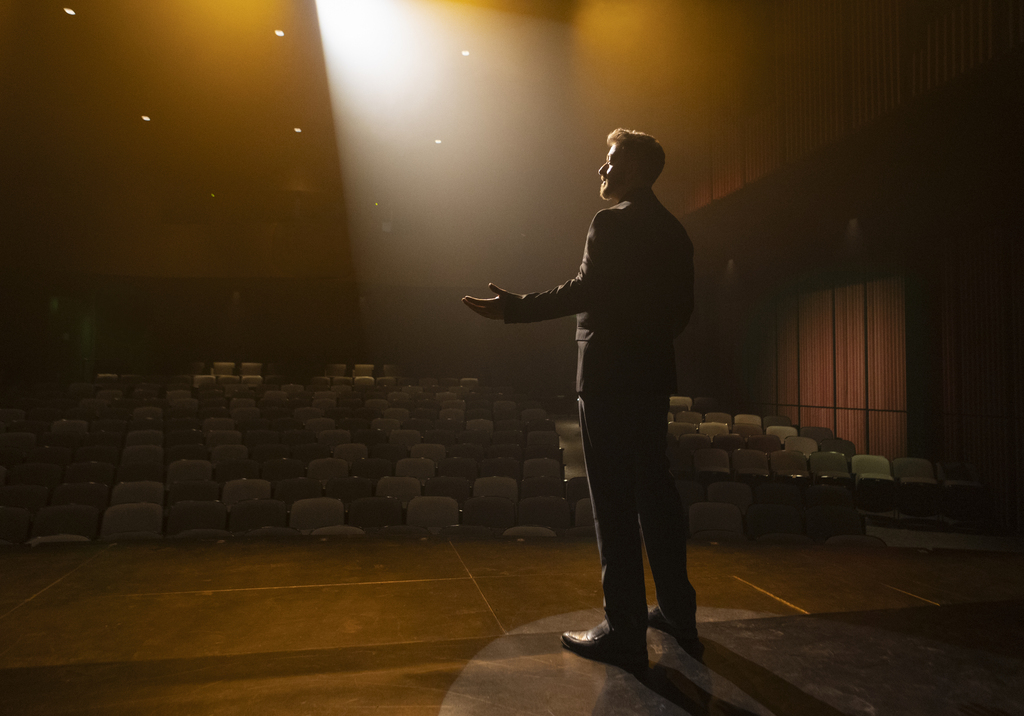
You have a special interest in immersive theater. What have been your favorite ways you’ve incorporated that for AMFA productions?
A good portion of my time at Northwestern was devoted to studying transmedia storytelling and immersive experiences, and I became fascinated by the ways stories can extend beyond a single medium and invite audiences into a more active relationship with the narrative. Media scholar Henry Jenkins describes transmedia storytelling as a process in which “integral elements of a fiction get dispersed systematically across multiple delivery channels for the purpose of creating a unified and coordinated entertainment experience.” That idea has stayed with me because it highlights how storytelling can become something audiences explore, inhabit and help bring to life.
One of the things I love most about immersive theater is that it invites audiences to become participants rather than observers. Instead of simply watching a story unfold, they help shape the experience.
We’ve explored that in several ways at AMFA. In our Theater for the Very Young productions, audience participation is built directly into the storytelling. In “A Tale of Two Flurffys,” children joined the actors onstage to help build a parade float and search for a missing friend. In “Flurffy in the Land of Almost Awake,” young audiences physically travel through sensory environments alongside the characters. Even our Shakespeare productions embrace participation through direct audience address and the breaking of the fourth wall. I love those moments when the distance between performer and audience disappears and, for a little while, everyone becomes part of the same story.
You’ve long been involved in the local stage scene outside AMFA walls. How does it stay fresh or still surprise you?
What continues to surprise me is the incredible depth of talent in Arkansas and the joy of watching artists grow over time. Some of my favorite moments have come from reconnecting with artists I met years ago as students or emerging performers and seeing the remarkable careers they’ve built.
Theater is unique because it’s always changing. Every production brings together a different group of people, different ideas and different life experiences. I learn as much from the artists I work with as they learn from me. Watching local artists continue to challenge themselves, take risks and evolve keeps the work fresh and reminds me that the creative journey never really ends.
AMFA’s theater program has more than 50 years of lore, now in a beautiful new facility. What is it like working within this confluence of time and inspiration?
It’s an incredible responsibility and an incredible gift. There are generations of Arkansans who have memories tied to this theater. Many people had formative artistic experiences here, just as I did. At the same time, we’re working in one of the most beautiful performing arts facilities in the region and imagining what the next 50 years might look like. AMFA combines visual art, performing arts and education under one roof, creating opportunities for collaboration and discovery that are rare. Every day feels like a conversation between legacy and possibility. We honor the artists, educators and audiences who came before us while continuing to explore new stories, new forms of engagement and new ways of serving our community.
With AMFA’s commitment to being a hub for the community, what presence do you hope its theater has in Little Rock?
I hope AMFA’s theater becomes a true gathering place for the community — somewhere people from all backgrounds feel welcome, seen and connected. I want us to be woven into the fabric of people’s lives, creating opportunities for shared experiences and meaningful engagement.
Whether you’re bringing a toddler to their first theatrical experience, attending a Shakespeare performance, seeing a concert, participating in a community event or engaging with one of our more thought-provoking productions, I want AMFA to be a place that sparks curiosity, conversation and connection.
One of the things I love most about theater is its ability to bring people together. It creates a space where we can laugh, reflect, learn and experience something collectively. Theater can certainly provide escape, but at its best, it also helps us understand one another. My hope is that AMFA continues to be a place where stories foster empathy, where community members can gather to explore different perspectives, where difficult conversations can happen with care and respect and where audiences leave feeling a little more inspired, a little more connected to each other and a little more hopeful than when they arrived.
Read more: Shakespeare Summer to Take Center Stage at the Arkansas Museum of Fine Arts
PHOTOGRAPHY
JASON MASTERS
SHOT ON LOCATION
ARKANSAS MUSEUM OF FINE ARTS