
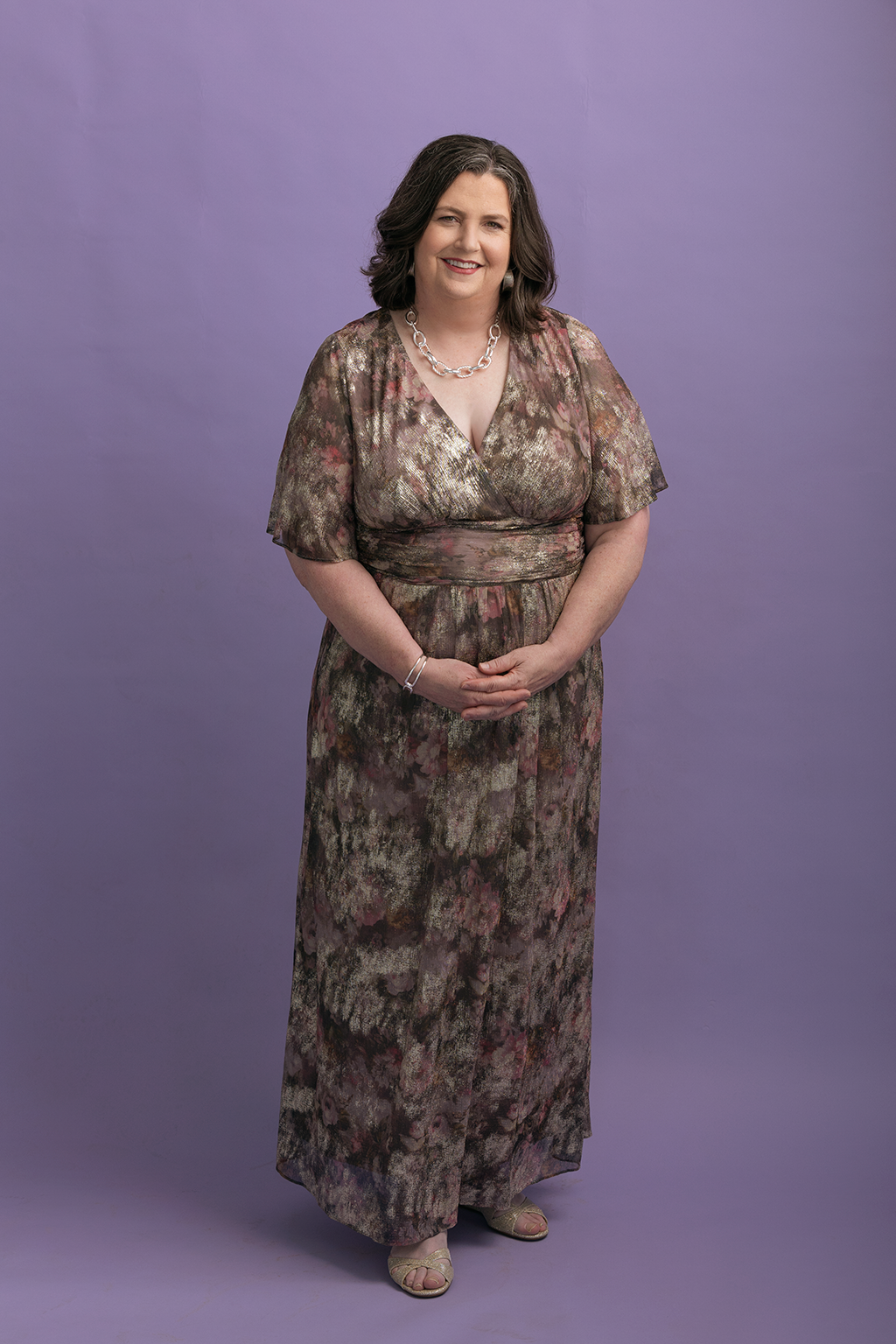
Trained in pediatrics and internal medicine, Dr. Karen Farst initially worked in northwest Arkansas as a private practice pediatrician, but volunteering as a medical provider with the Children’s Advocacy Center of Benton County profoundly shifted her focus.
“It was really through that experience, and working in a team-based setting and learning more about the medical response to child abuse, that I decided to leave private practice and complete an additional fellowship training in child abuse pediatrics,” she says.
After completing her fellowship, Farst joined the Team for Children at Risk, a joint effort between UAMS and Arkansas Children Hospital. And in 2009, the inaugural year the American Board of Pediatrics recognized child abuse pediatrics as a separate speciality, she became the first doctor in the state to be board-certified in child abuse pediatrics.
To honor her pioneering work and long-time support, Children’s Advocacy Centers of Arkansas (CACar) will present Farst with the 2025 Inspire Award at its Inspiration Gala in October.
“Dr. Farst is nationally known as a physician for child abuse, she has presented at national conferences and she’s on boards at our national headquarters,” says Elizabeth Pulley, CACar’s executive director. “Not every state has a physician like her.”
The evening, capped off with a fashion show from local boutique Barbara/Jean, will also celebrate the work of children’s advocacy centers (CACs) across the state.
And CACar’s work does indeed span the state, supporting 32 CACs and 64 multidisciplinary teams, providing training and consistency so that, according to Pulley, “the response to child abuse looks the same, no matter where you are.”
CACs are designed to be the one stop for child abuse victims and their non-offending family members. Services including medical exams, forensic interviews, mental health services and family advocacy are provided at no cost to victims. Forensic interviewers, whose work is often used in prosecution, must go through specialized training that is only available in the state through CACar.
Farst’s work at ACH, where she serves as chief medical officer and has spent more than 20 years with the Team for Children at Risk, is entwined with the work CACs do in their communities.
“If a child has been neglected or abused, there are only two places that are equipped to do a medical exam, and that is Arkansas Children’s Hospital or a CAC in Arkansas,” Pulley says.
Farst and her team have been crucial in standardizing child abuse medical care in Arkansas by implementing training processes and peer review for CACs across the state and acting as a sounding board for medical professionals who need someone to consult with during an exam.
Collaboration between law enforcement, child protective services, mental health and medical providers is also crucial to effective care for CACs. And in 2025, CACar is taking its collaborative approach to the next level.
“Last year, we gathered all of our state level partners and wrote a child abuse response protocol that outlines what every agency is supposed to do in response to a child abuse case and then how those agencies work together,” Pulley says. “This is the first time in Arkansas we have had a comprehensive child abuse response like this.”
According to Pulley, CACar’s commitment to thoroughness has even the national organization taking notes.
“The best approach is the collaborative approach, and that’s why we have multidisciplinary teams in Arkansas,” she says. “It’s in state law. It’s important, it’s national best practice and now we got everyone to the table to develop this protocol, and we’re rolling out with it.”
“Arkansas is definitely known for being progressive in this area,” Farst says.
The challenge going forward, she notes, will be recruiting more medical professionals into the field and diversifying support as some funding may be at risk.
“I think that’ll definitely be a challenge for the CACs to not lose ground,” Farst says. “We want to continue to make progress and not have to cut back on programs because of funding constraints.”
Farst knows all too well both the immediate and far-reaching benefits of CACar’s work.
“A lot of times with child abuse cases, you really only get one chance to recognize what’s going on, intervene, get people to a safe place,” she says.
And that may just be step one, but it’s where long term outcomes begin.
“It really centers around trauma-informed mental health care, and the CACs have been at the forefront,” Farst says. “It’s not only about the immediate protection, it’s thinking about the health of our state and trying to decrease the cycle of people not being able to escape the situation where they do not have the opportunity to live their best life and reach their best potential.”
THE INSPIRATION GALA
Benefiting the Children’s Advocacy Centers of Arkansas
Oct. 16, 7 p.m. | Statehouse Convention Center
Info: inspirationgala.com
PHOTOGRAPHY
JASON MASTERS
HAIR & MAKEUP
LORI WENGER
CLOTHING
DILLARD’S