
Fifty years ago, attendees of CARTI’s inaugural holiday fundraiser gathered in a hospital lobby to bid on decorated Christmas trees, raising $7,000 for cancer care. Today, that modest function has become one of Little Rock’s premier winter traditions and a foundational element of CARTI’s compassion, cutting-edge cancer care and community resilience.
Serving as event co-chairs for the golden anniversary of the Tux ‘n’ Trees gala are Dr. Scott and Cindy Stern, whose lives have intertwined with CARTI since its early days. A former chief medical officer and recently retired head and neck surgical oncologist, Scott joined CARTI in 2011 and helped develop the clinical blueprint that transformed the organization from a specialized radiation therapy provider into the comprehensive institute it is today.
As longtime champions of CARTI’s mission, the Sterns bring a personal perspective to the evening, having witnessed an ambitious vision progress into a world-class center touching countless lives.
Central to that evolution was a fundamental shift in how and where treatment was delivered.
“If you ask me what the most transformative thing has been, it’s not a technological advancement, it’s [clinic] placement,” Scott says. “It’s being there and bringing cancer care to where people are. That’s been the biggest change.”
Bringing that philosophy to life required both vision and significant capital. Scott played a pivotal role in CARTI’s successful $10 million campaign to build its flagship Little Rock cancer center, followed by comprehensive care centers in Conway, El Dorado, Heber Springs, North Little Rock, Pine Bluff and Russellville, laying the groundwork for the CARTI Surgery Center and The Bridge support services center.
For patients and their families, consolidating these resources under one roof changed the grueling reality of cancer therapy.
“Back in the day, you would go to one doctor in one location, then go see the surgeon somewhere else and then have to come back another day to get your scan done by the radiologist,” Cindy says. “Now everyone is in one building, [doctors] can all talk to each other and sometimes the patient can knock out most of their appointments in one day.”
Scott says the developing approach to cancer treatment further underscores the importance of comprehensive care centers.
“Forty years ago, I never imagined we would view some cancers as chronic diseases, shifting the conversation from cure and remission to living with cancer,” he says. “Today, some people with cancer can receive ongoing care and ultimately die from another cause. That is a remarkable change.”
Meeting those long-term needs depends on a patient-first culture sustained by strong community support. Fundraisers such as the three-day Festival of Trees, for which the gala is the grand finale, have fueled CARTI’s growth and expanded patient programs across multiple locations.
“The culture [around CARTI] has always been positive,” Cindy says. “The most important part to me is that everything is always centered on the patient.”
“Culture is an organization’s lifeblood,” Scott adds. “The challenge is to identify, nurture and maintain it, especially during rapid growth. Doing so requires difficult conversations and decisions.”
What sets CARTI apart, he notes, is its ability to turn those challenging discussions into decisive action.
“I say this all the time — CARTI doesn’t just talk about doing stuff; CARTI does stuff,” Scott says. “They [see a need] and they just do it.”
That action-oriented mindset extends beyond the clinical setting. CARTI provides financial assistance for everyday barriers such as transportation and lodging while also funding often-overlooked services that support the whole patient, including dietitian guidance, wig fittings, counseling, massage therapy and, when needed, hospice care. And the safety net doesn’t just cover the person receiving treatment.
“Not only does the patient need care, but also their caregiver, sometimes even more,” Scott says. “Making services available to the caregiver is a huge deal, and we know that’s something we have to support.”
Scott knows these services may not always make financial sense on paper, which makes CARTI’s commitment to providing them especially meaningful.
“These are not billable procedures,” he says. “Organizations must decide what matters most and what they are willing to fund, even at a loss. That is why events such as the Festival of Trees are so important.”
“The comprehensive care of it all has to be under one roof or those things don’t happen,” Cindy adds.
It is a model made possible entirely through community partnership.
“For 50 years, the Festival of Trees has represented something much greater than an event,” CARTI CEO Adam Head says. “It represents a community coming together to bring hope, healing and cancer care to patients and families across Arkansas.”

Like the organization itself, the CARTI Auxiliary’s Festival of Trees has changed a lot since that 1976 debut in the CARTI lobby at St. Vincent Infirmary. By 1977, the celebration officially adopted the name “Festival of Trees” and expanded its programming, introducing a weekday cocktail hour ahead of the weekend Tux ‘n’ Trees gala.
“The idea of the trees and having a decorated tree to auction off is very unique,” Cindy says. “That’s a fun aspect that no one else has. Trying to be different is always hard, but I think CARTI does a really good job of that.”
Over the decades, the venues and programming evolved into today’s full weekend of three signature events: the Sugar Plum Ball, Festival of Fashion and the black-tie Tux ‘n’ Trees gala, which closes the celebration in style. To date, Festival of Trees has raised more than $12 million for the patient assistance fund. This year, they hope to raise a record-breaking $1 million.
“No matter the format, the purpose behind the holiday weekend remains the same: to support those facing cancer when they need it most,” says Jennifer Selig, executive director of the CARTI Foundation.
That enduring spirit is embodied not just by its leadership, but by the dedicated volunteers who return year after year. This year’s volunteer honoree, Shelia Vaught, has supported CARTI and Festival of Trees since the early days as well, demonstrating that every volunteer role matters. She began by serving coffee to patients in the lobby and cleaning up after the gala. Today, she choreographs the fashion show and adds her special touch to every event throughout the weekend.
“Our festival has changed and grown over the years, but our mission never has,” Vaught says. “We still want to make the best positive impact we can on cancer patients of Arkansas. Once that mission hit my heart, I knew I was hooked on CARTI forever.”
Her steadfast dedication makes this anniversary celebration particularly poignant as CARTI honors her decades of service.
“It was an unexpected honor, but it makes me feel very happy,” Vaught says. “Festival of Trees is such a family, and so many of the volunteers like me have been around for so long. It’s amazing to see people come back every year, and we love it. It’s our favorite week of the year.”
Vaught says she and her team are keeping some surprises under wraps, but each event will be elevated for the 50th anniversary, with rooms adorned in golden hues to match the theme.
Ultimately, as CARTI celebrates half a century of transforming cancer care, Festival of Trees reflects both the power of community and the impact of steady, thoughtful leadership. For Scott, who hopes to be remembered simply for making balanced, fair and reasonable decisions throughout his tenure, the gala marks the culmination of a career dedicated to guiding the organization with purpose.
“We are honored to have two of CARTI’s most ardent supporters — both of whom have seen firsthand the impact that Festival of Trees has on improving patients’ outcomes and quality of life — chairing Tux ‘n’ Trees during this milestone year,” Selig says.
“It’s been an incredible blessing to be part of this and have this experience be the last 15 years of my career,” Scott says. “I never saw it coming, but it’s been great.”
His approach has shaped CARTI’s growth and unified its mission from the clinic to the ballroom. As Cindy sees it, “Scott’s legacy will be bringing all the pieces together,” a fitting tribute to a leader whose work helped turn a vision of compassionate care into an enduring reality.
“The generosity and support of our auxiliary, volunteers and donors have helped CARTI grow and evolve alongside the needs of the patients we serve,” Head says. “Helping our neighbors experience more of life’s meaningful moments is a legacy worth celebrating, and one we are incredibly grateful to carry forward together.”
The CARTI Auxiliary Festival of Trees: A Timeline
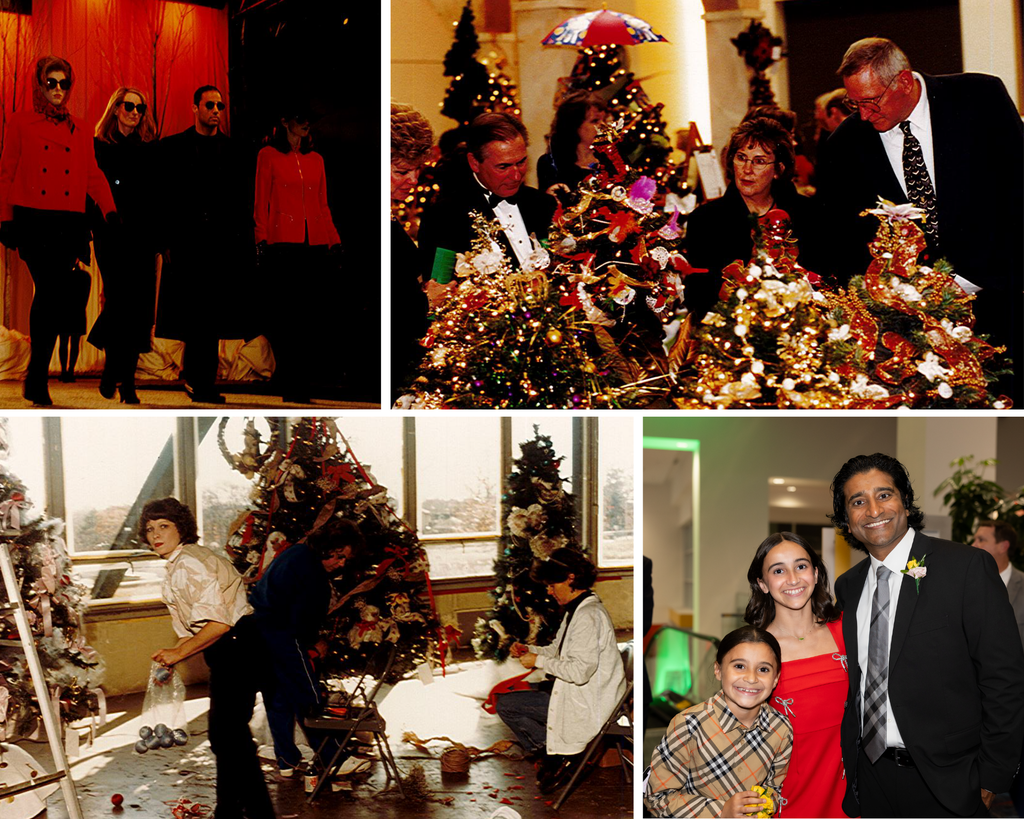
1976: CARTI hosts its first holiday fundraiser with fully decorated trees for auction.
1977: The CARTI Auxiliary officially names the event “Festival of Trees,” adding a cocktail hour during the week and Tux ‘n’ Trees on Saturday.
1978: The event transitions to Rick’s Armory in downtown Little Rock as ticket sales grow.
1980s: Festival of Trees introduces Family Day and the Ladies Luncheon, the precursor to Festival of Fashion.
Early ‘90s: CARTI moves the event to the Camelot, the former DoubleTree, and introduces the Teddy Bear Tea, now the Sugar Plum Ball.
Mid-‘90s: The CARTI Auxiliary switches to the Statehouse Convention Center, adding another family-friendly event with the American Girl and Ice Cream Socials.
2001: Clear Channel Metroplex becomes the new venue as the CARTI Auxiliary officially unveils the Sugar Plum Ball.
2002: Festival After Dark, a holiday mixer, and Breakfast with Santa join the lineup.
2008: The CARTI Auxiliary returns to the Statehouse Convention Center’s Wally Allen Ballroom to accommodate its ever-growing attendance.
2013: Festival of Fashion, a New York Fashion Week-style runway show, becomes an early evening event.
2015: Breakfast with Santa sunsets as the Sugar Plum Ball continues to be a sell-out.
2018: CARTI celebrates its final Festival After Dark.
2020: Festival of Trees goes virtual due to COVID-19.
2023-25: CARTI continues to shatter fundraising records.
2026: CARTI marks 50 years of Festival of Trees, an event that has raised more than $12 million to support Arkansas cancer patients and their families.
CARTI’S 50th Annual Festival of Trees
Statehouse Convention Center
Sugar Plum Ball | Nov. 12, 6 p.m.
Festival of Fashion | Nov. 13, 7 p.m.
Tux ‘n’ Trees Gala | Nov. 14, 6 p.m.
Info: carti.com/festivaloftrees
PHOTOGRAPHY
JASON MASTERS
HAIR & MAKEUP
LORI WENGER
CLOTHING
UNVEILED BRIDAL COLLECTION
CLUTCH
BARBARA/JEAN