
“That’s a lot of concrete.”
It’s 4,300 SF of it, in fact. Now coated in 26 gallons of primer, 28 gallons of acrylic paint and 20 gallons of UV-resistant, anti-graffiti varnish, what once was a large, bleak wall at the corner of 6th and Main Streets in downtown Little Rock is now the home to 30-feet-tall koi fish.
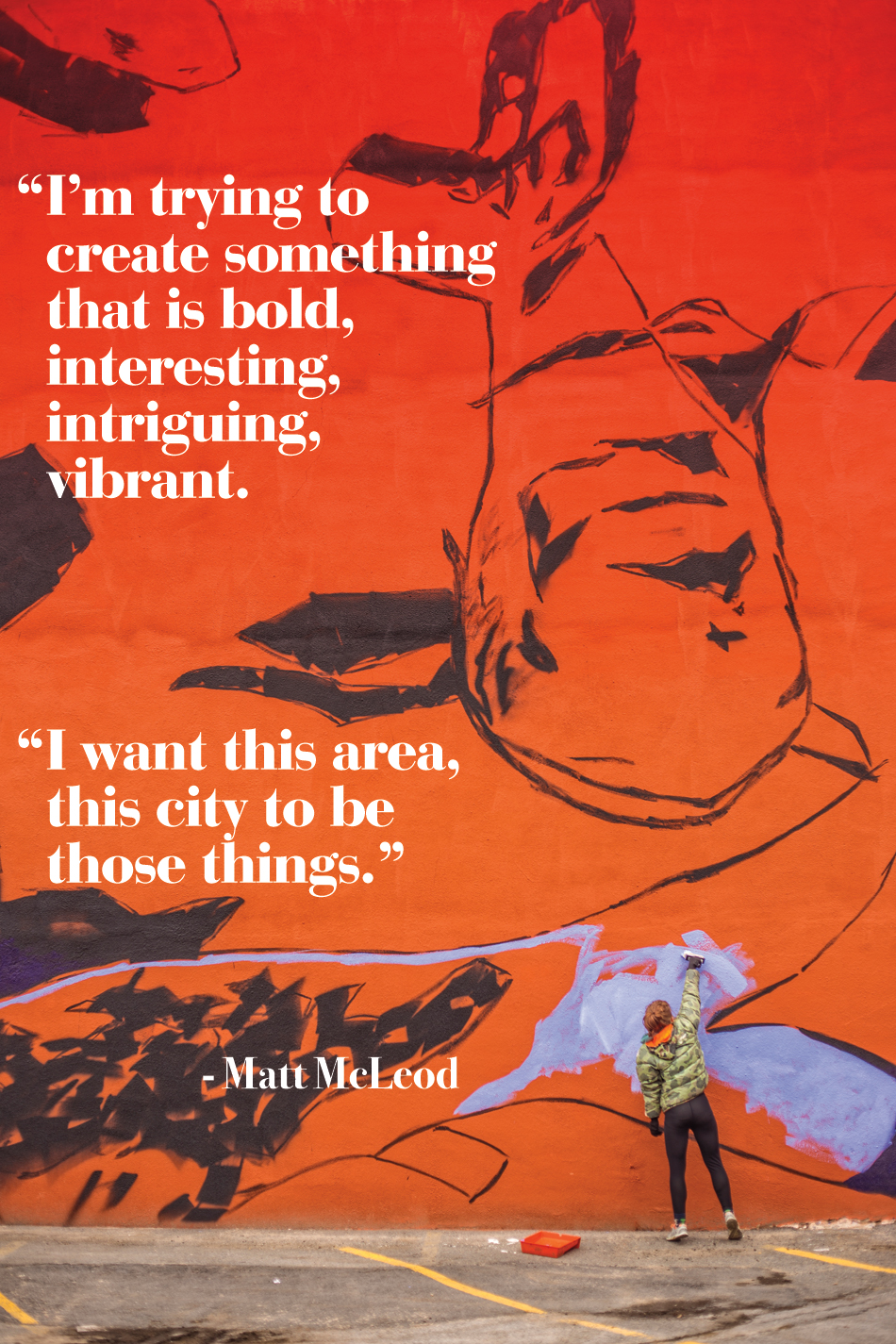
Matt McLeod is behind the city’s most eye-catching new public artwork, a giant energetic mural with a triad of secondary colors orange, green and purple titled “Beneath the Surface.” It’s painted on the side of Bennett’s Military Supplies, right at the intersection of the Creative Corridor heavy hitters: the Arkansas Repertory Theatre and future homes of Ballet Arkansas and the Arkansas Symphony Orchestra.
“The arts have long been considered igniters of change, public art included. Art created in or on a public space suddenly makes it a place, and places draw people,” Downtown Little Rock Partnership Director of Public Relations, Communications and Membership Becky Falkowski says. “Matt’s ‘Beneath the Surface’ adds to the overall goal of the Creative Corridor: to turn the corner from President Clinton Avenue and Markham down Main Street, and use the arts to help rebuild the Main Street economy, while creating a vibrant place in which to live, work and play.”
This hotbed of creativity is also the future location of McLeod’s new fine art gallery, which will be housed in the old Pfeiffer building with Ballet Arkansas, directly across the street from the mural. Poised in an ideal location, both the gallery and the mural stand as a testament to McLeod’s passion for the sweeping changes happening downtown.
“I’m from Little Rock,” he says. “I drove up and down Main Street a lot and thought what a shame it was. This is my Main Street. This is my city and it’s boarded up.”
But these establishments mean even more than that for McLeod.
He graduated from college with a degree in communications and advertising. He’d always loved the creative outlets of the artistic process, but didn’t think it feasible to actually make a living as an artist.
After he graduated, McLeod took the first job he could get, in the media planning department at an advertising firm in Dallas. He was caught in the drudgery of being the lowest man on the totem pole for a few years before connecting with Wayne Cranford and landing a job at Cranford Johnson Robinson Woods, bringing him back home to Little Rock.
It was around that time that McLeod started taking painting and drawing classes at the Arkansas Arts Center in order to explore that creative desire. He fell fast for making art, but it also finally solidified a daunting fear: He was in the wrong profession.
“There was a moment when my dad asked me what I really wanted to do. I told him I didn’t know, but that when I’m painting, I feel like I’m closer to God. He said, ‘Then you have got to do that.’ It was then I knew that art was my greatest talent, and that it would be a shame and a waste not to pursue it.”
However, with a family, responsibilities and a steady paycheck, it’s hard to leave a nine-to-five life. Fast-forward 15 years and McLeod was in the middle of a career he didn’t really love, knowing he needed to make a change, but unsure how to do so.
In an oddly fortunate turn for McLeod, the advertising world took a hit in the post 9/11 world and the company he was then working for had to make cuts, meaning McLeod was out of an ad job. His boss didn’t want to see him go, but also couldn’t let McLeod leave without one final observation:
“He told me I was never supposed to be here. He was right,” McLeod says.
In truth, McLeod had been trying to figure out a way to solely be an artist for a long time, but he was afraid to make the jump into unfamiliar waters. He was at first shocked by the news of the layoff, but within minutes felt a huge burden lifted, already looking forward to his future adventures in the art sphere.
“Sometimes you find yourself in a place, and you know you’re not supposed to be there, but you don’t know what to do about it. And sometimes, you can try to approach it pragmatically, but then a sign appears. I treated this as that and just started running.”
But he didn’t run blindly. Those 15 years in the fast-paced advertisement world had equipped him with the skills to become a unique blend of artist and businessman that you almost never see married into one mind.
Not only does McLeod have the technical savvy and zeal of a painter, but the talent and desire to communicate clearly with clients and create business plans, working on timeframes and within budgets, the two things artists are notorious for deploring.
“My past business practices really gave me a very practical outlook on being an artist as a business,” McLeod says. “That’s a refreshing change of pace for a lot of people and has worked to my advantage.”
That particular fusion came most in handy when making the shift into the life of a full-time artist. His business sense told him he couldn’t just paint paintings and try to sell them. It was far from a financial walk in the park, but through selling art, conducting workshops and a combination of other tasks, he’s now at a comfortable place.
McLeod may not exactly know where his next check will come from, but his continued drive toward new projects and opportunities has landed him right in the middle of the Creative Corridor movement.
Relationships and talks with different city leaders and other local artists began with public art ideas that didn’t quite come to fruition, but McLeod recognized something compelling: He’d been given a seat at the table, and he wouldn’t take it for granted.
By staying involved and asking questions, some important people in the Creative Corridor process invited McLeod into the conversation about how to plan it, what makes a successful redeveloped downtown, what would make it a vibrant place, what an artist would need in an environment.
Eventually, McLeod took to the Pfeiffer building, transforming it into a bright, open area that now boasts about 2,000 SF of visual art gallery space, which will include local painters, sculptors and even furniture makers. There are even residential spaces upstairs, which he hopes to fill with artists.
It was in the meetings and scouting of this building when the Bennett’s wall captured McLeod’s interest. After all, how much bigger of a canvas could he get? He was advised to create a proposal for a mural just in case the opportunity ever arose in the future. And he did.
Because the city doesn’t have the type of funding for a project that large, McLeod pitched it to the Educational Foundation of America, an organization that specializes in creative place-making, and they funded the mural.
Ideas were tossed around ranging from patriotic themes as a nod to Bennett’s to a collage of famous Arkansans, but those left a bad taste in McLeod’s mouth, feeling hokey and wrong for the vibe the Creative Corridor was trying to achieve. He eventually landed on taking a slice from a piece he’d already created. Enter the koi.
“Everyone always asks me ‘Why fish?’, but that’s not the point. The koi don’t have a deeper significance, but what I’m trying to create with the koi does. I’m trying to create something that is bold, interesting, intriguing, vibrant. I want this area, this city to be those things.”
Maybe the most appealing part of the mural is that it isn’t trying to get a heavy, underlying message across. This isn’t something that got hijacked by other people’s agendas, but a true piece of art for art’s sake, straight from the artist’s imagination.
Six weeks and over 350 hours of work later, complete with snow, lightning and a team of UALR and UCA students lending a hand, “Beneath the Surface” now serves as a flag planted squarely into the ground, marking a turning point for the future of the Creative Corridor and of Little Rock.
“I haven’t seen this sort of excitement in Little Rock in my lifetime,” McLeod says. “When it’s all said and done, I want to look at this and say that I did something down there, that I had a say in it, I helped create really cool art there. That’s what I want: to have been in the mix of it all.”